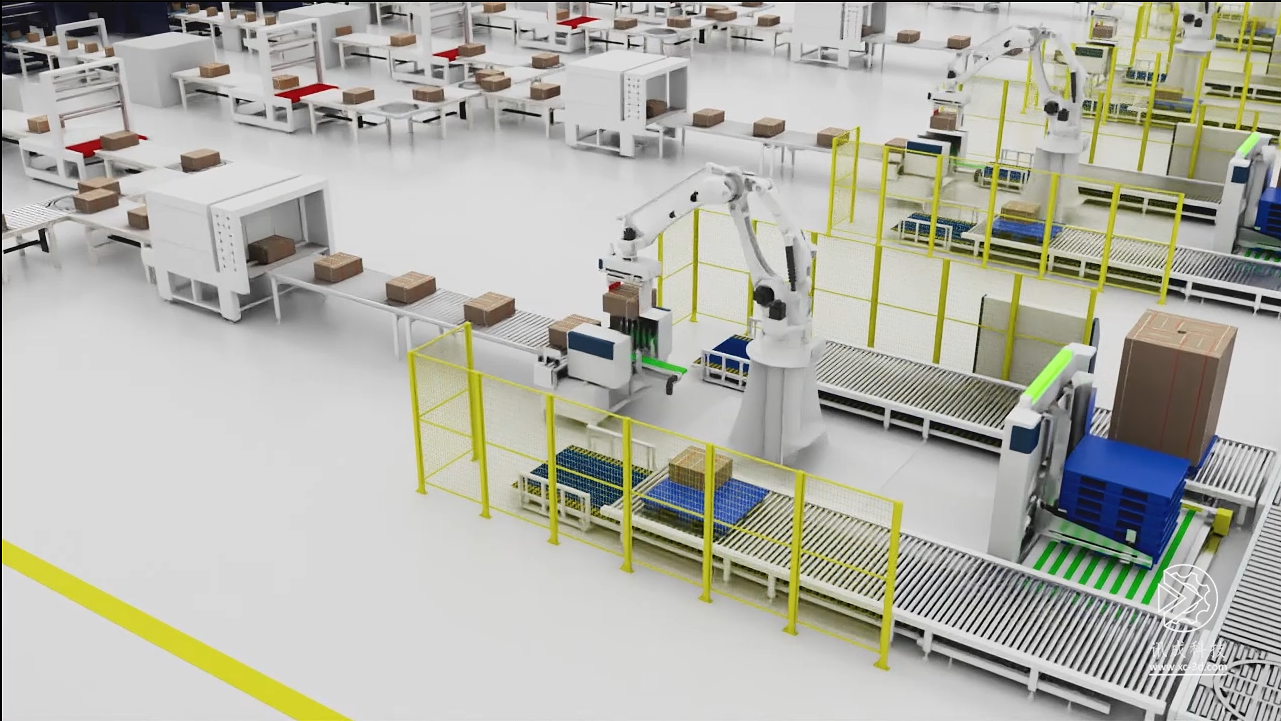
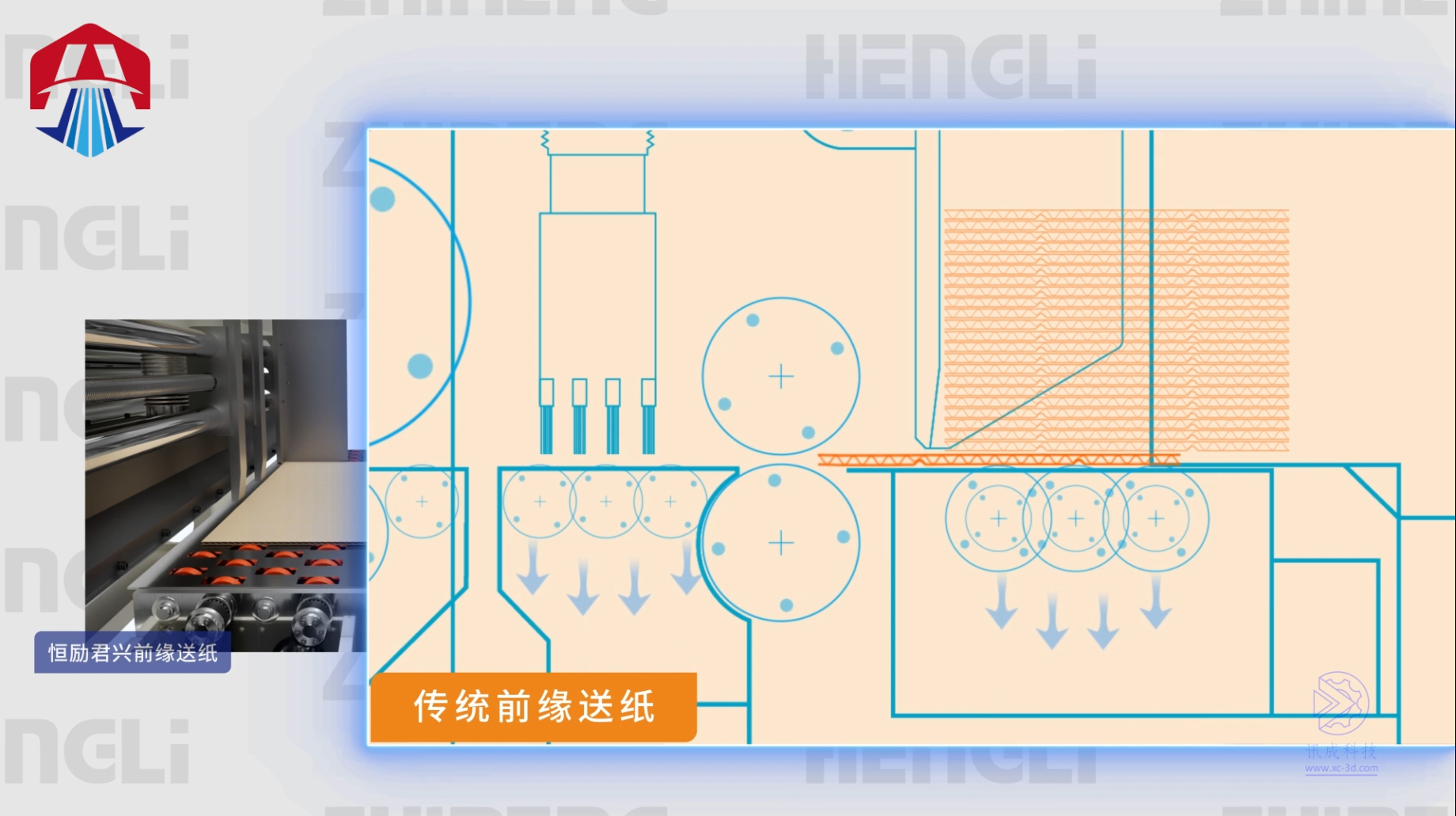
Friends familiar with flexo printers have more or less encountered such problems: rubber roller feeding causes slippage at the paperboard scoring line, rubber rollers cause crushing of corrugations during transmission, and feeding becomes skewed after the middle section of the rubber roller wears out... But after we produced the animation for Guangdong Hengli Intelligent's front-edge non-pressure feeder, we were pleasantly surprised to find that these problems have been optimized!
New vs. Old Comparison: An Overview of Traditional Equipment Challenges

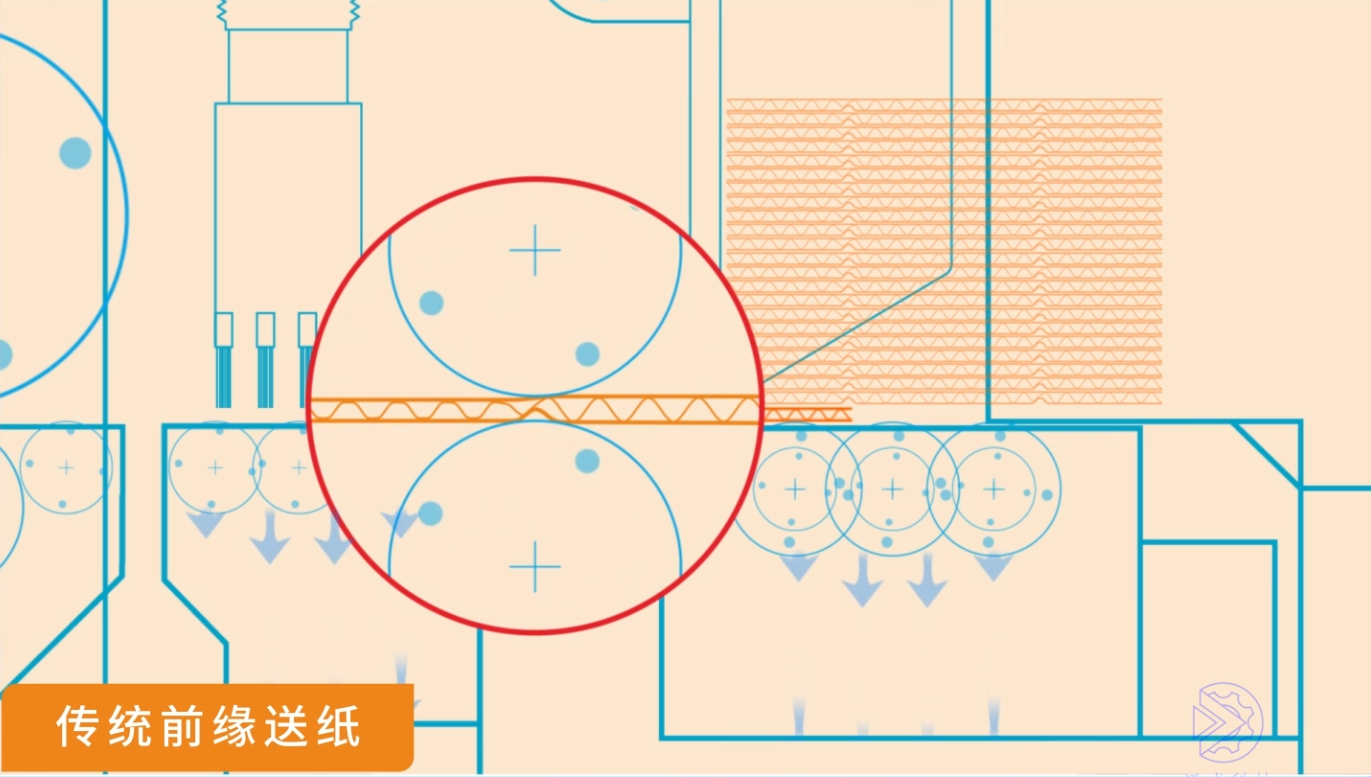
In the animation produced by Xuncheng for Guangdong Hengli Intelligent, we adopted a comparison method between new and old equipment, using 2D to represent traditional equipment and 3D for new equipment. This allows the correspondence between the new and old to align with most people's conventional thinking while highlighting the differences between the two types of equipment. Finally, with the application of zoom-in camera effects, the reasons for slippage at the scoring line during traditional printing rubber roller feeding and the crushing of corrugations are thus demonstrated.
Clever Use of Reference Frames: Difficult Problems Visible to the Naked Eye
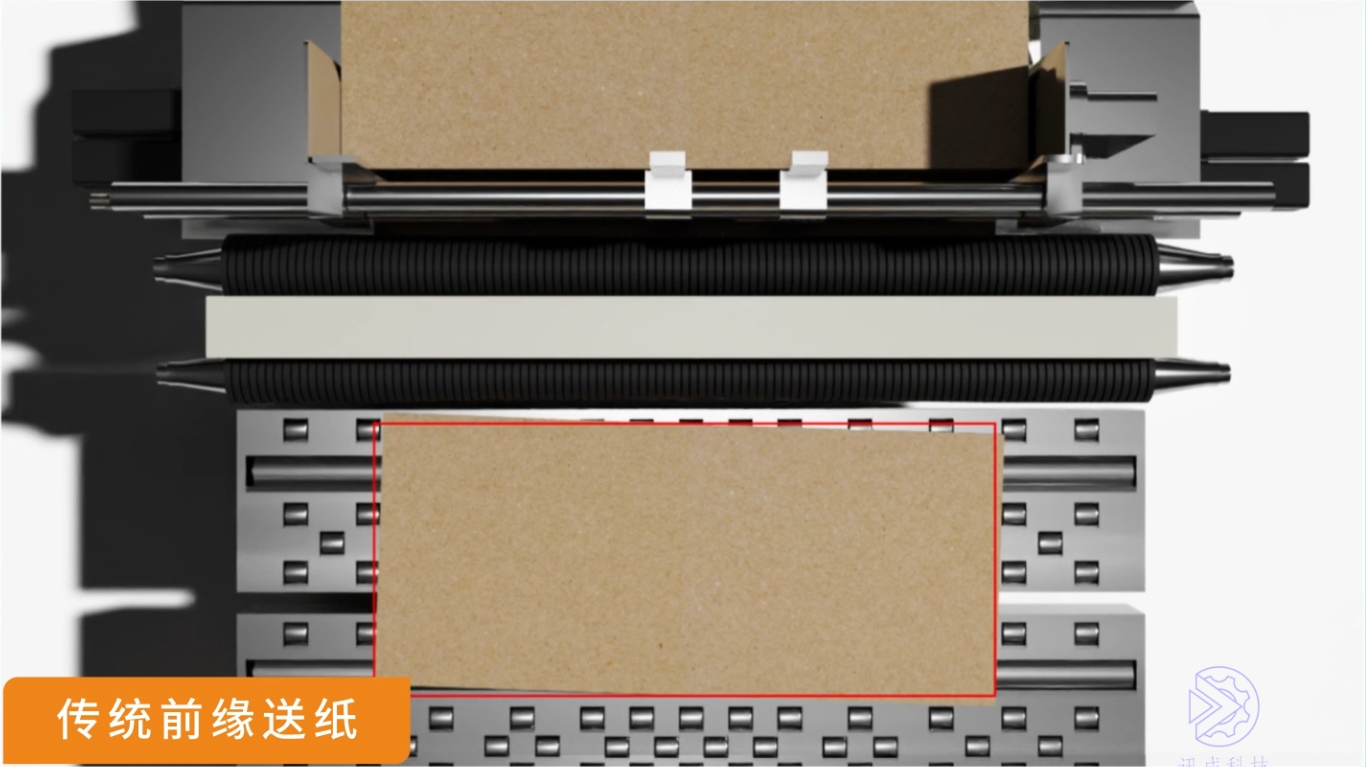
To vividly demonstrate the problem of paperboard skewing during feeding in traditional flexo printers, we added a red square reference frame in the animation. Combined with the connection of front and rear shots, using a 3D to 2D transition technique, the wear of the rubber rollers and the skewing of the paperboard were presented one by one.
Perspective + Layer Packaging: New Equipment Highlights at a Glance
Perspective and bright-colored layer packaging are techniques we often use when creating industrial 3D animations. Generally, perspective is used to clearly show the viewer the location of key structures while weakening the visual interference of surrounding irrelevant structures; bright-colored layer packaging with a technological feel is typically used in areas with special equipment designs to highlight key parts of the image.
1. Perspective
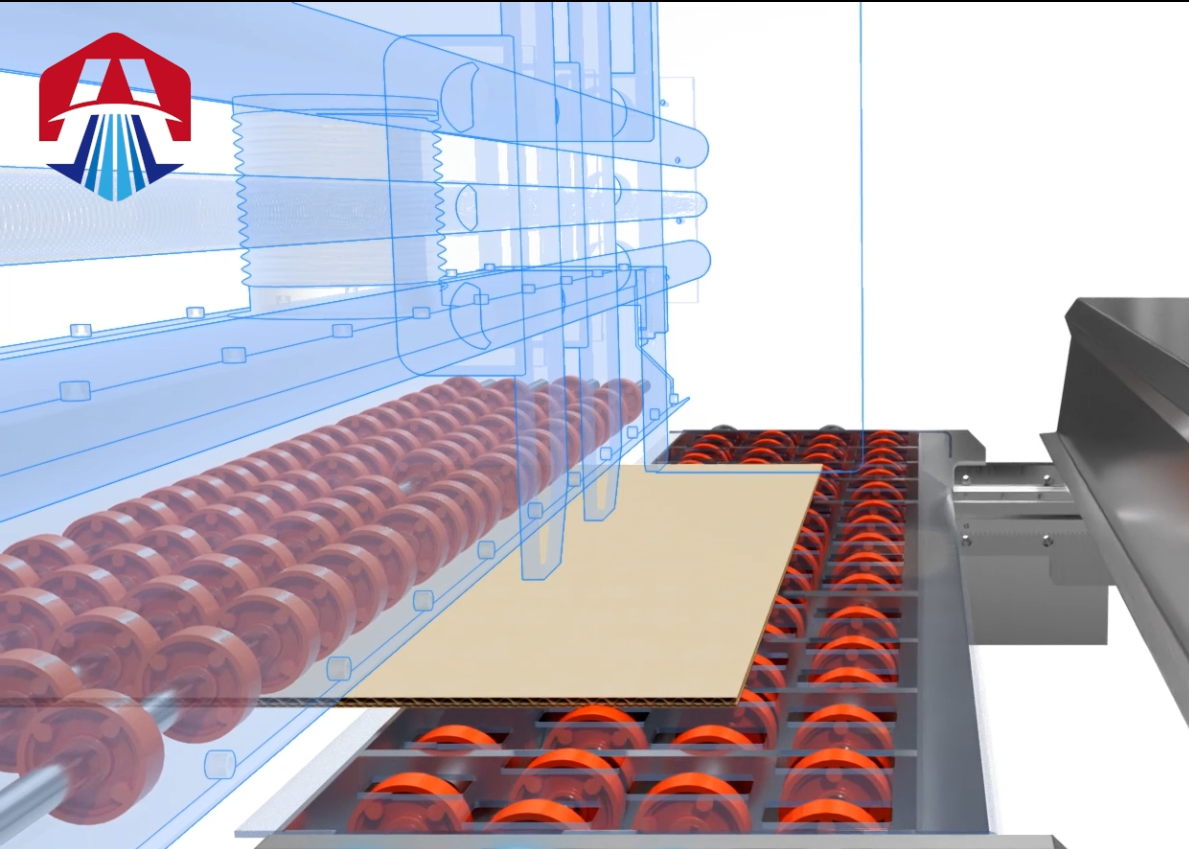
Due to Hengli's front-edge non-pressure feeding structure, which abandons the traditional rubber roller structure and uses a vacuum structure for transmission, in the animation demonstration, we used perspective to show the covers of the front-edge non-pressure and servo transmission, as well as the front baffle structure of the printer. This allows viewers to directly see the internal details of the equipment. Through this perspective, it is fully demonstrated that Hengli's equipment solves the problem of sudden loss of force at the scoring line from the upper and lower rubber rollers, has no rubber roller wear issues, and makes the entire paperboard transmission process more stable and smooth.
2. Futuristic Bright Layer Packaging
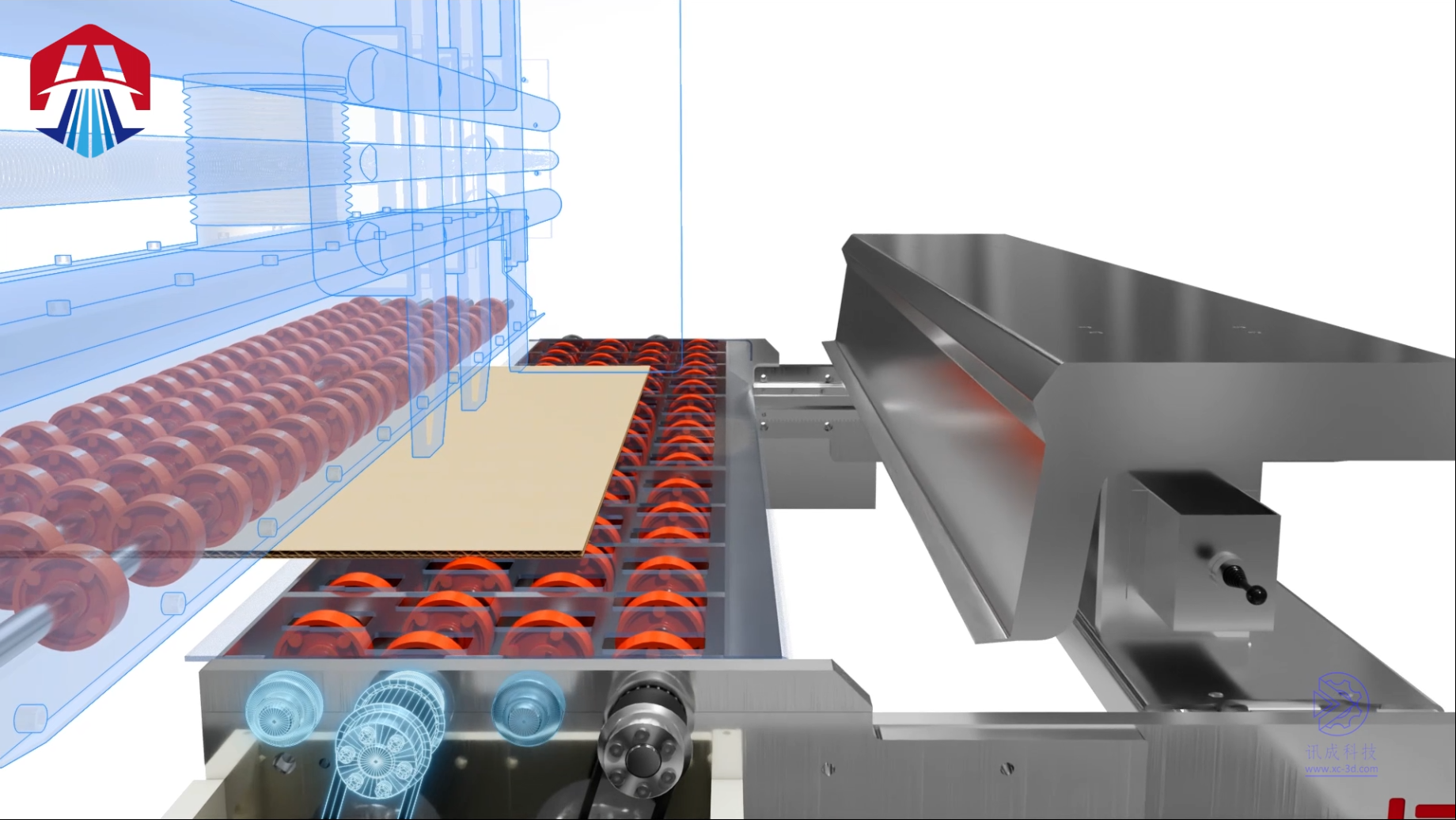
When designing to express the effect of the four axes starting synchronously during paper feeding and stopping segmentally at the tail, we not only applied perspective but also added a blue packaging treatment to the axis heads of the four feeding axes in the front section. Through the animation playback demonstration, viewers can see that the four axes of the equipment start synchronously during feeding. When the paper tail passes the 4th axis, the blue packaging on the axis head fades out, and this axis stops rotating. When it passes the 3rd axis, the blue packaging also fades out, and this axis stops rotating. This continues progressively, expressing the effect of synchronous startup followed by segmental stopping.
So, who should see such an animation? Can it help companies break through in overseas sales?
“In foreign countries, even if sales personnel use typical Chinglish, when they play the English version of the animation for foreign customers, they can achieve smooth communication with customers. This has also become a communication method that our foreign customers greatly appreciate,” said Mr. Xu from Hengli Intelligent.
Selected FAQs:
Q: Are animation videos expensive?
A: The price of animation videos varies greatly, mainly depending on production difficulty, duration, style creativity, production cycle, and service content. On the surface, animation videos are not cheap, with prices often in the tens of thousands, hundreds of thousands, or even hundreds of thousands of yuan. However, for high-end promotional videos of industrial products and machinery, animation videos offer high cost-effectiveness.
1. Replaces traditional paper brochures, is intuitive and easy to understand, spreads quickly, and reduces reliance on experienced salespeople.
2. Animation videos are of high quality, perfectly showcasing many details, unique functions, and structures, making it easier to engage in in-depth communication with clients.
3. Animation videos can be made interactive, increasing customer engagement.
Q: How long is the production cycle for animation videos?
A: The production cycle of animation videos is greatly influenced by various factors:
1. Timeliness and completeness of materials provided by the client.
Materials that the client needs to provide include: 3D models of products or equipment, video scripts, company LOGO, and company information.
2. Complexity of animated scenes and equipment. For example, demonstrating the internal structure of a car speeding down an avenue is much more complex than a static display of a bicycle.
3. Timeliness and effectiveness of communication between both parties during production.
Under normal circumstances, producing a standard 3D animation video takes 15-20 days. For complex models or large scenes, it requires 30-60 days, or even longer.
Q: When is it suitable for companies to produce 3D animations?
A: The following three time nodes are more suitable for producing promotional 3D animations:
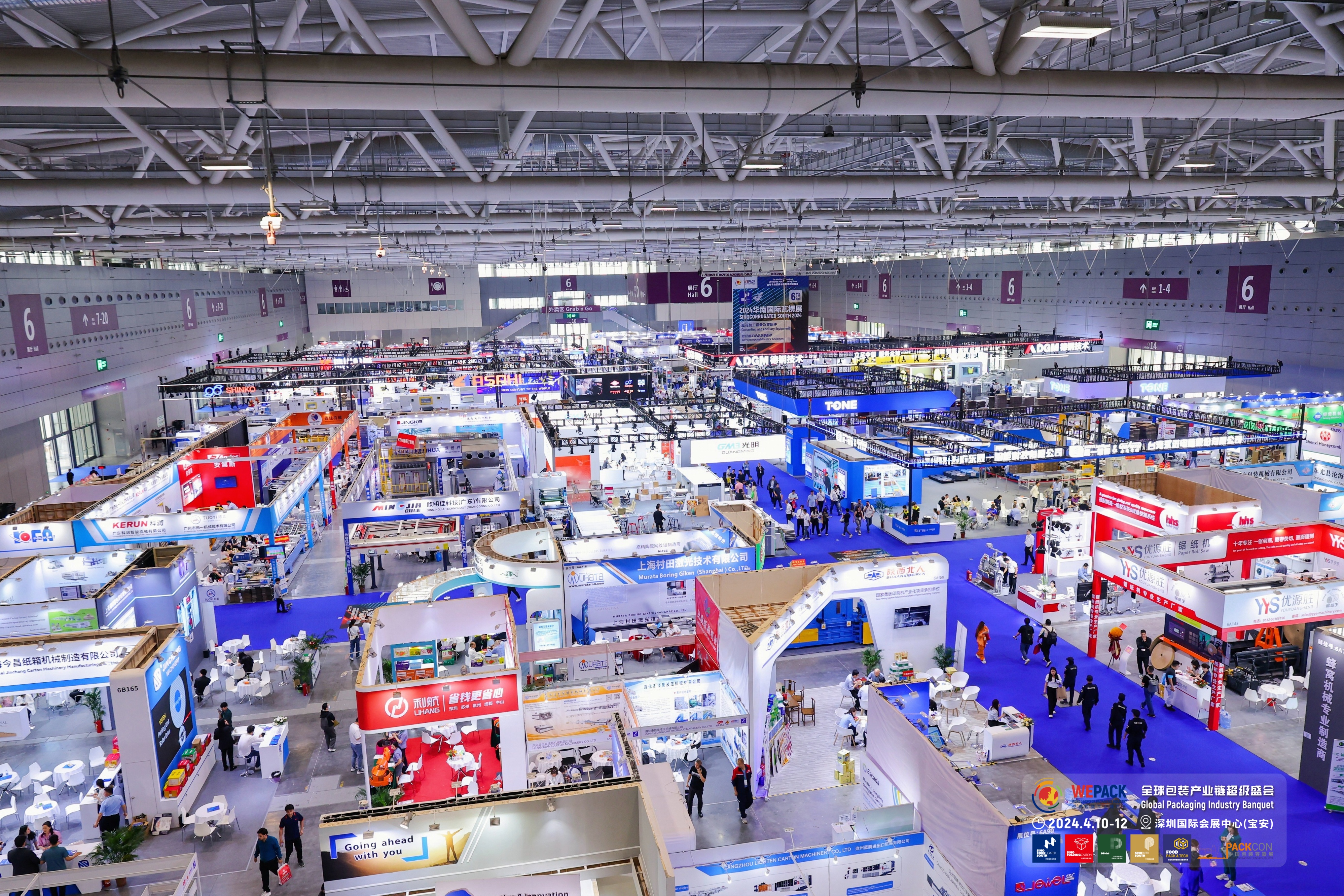
1. Before trade shows. It's best to have the animation video ready 15-30 days in advance to build anticipation for the exhibition;
2. New products or equipment are about to be launched;
3. Major client visits and exchanges.
4. Product R&D phase: Assists in inter-departmental communication and collaboration within the company; helps attract investment or cooperation opportunities; simulates design issues in advance, reducing R&D costs and risks;
5. Internal training phase
It should be noted that 3D animation videos have a certain production cycle. It is best to communicate with the production company in advance to arrange the production time reasonably.
About Xuncheng Technology
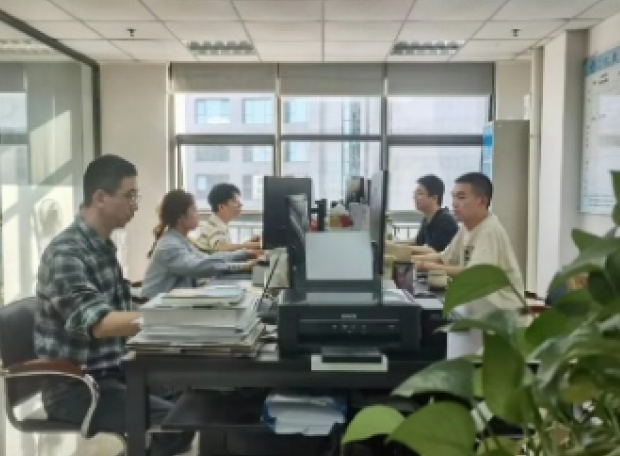
Founded in 2016, with 9 years of professional industrial 3D animation creation experience, clients span various types of enterprises including startups, overseas clients, listed companies, and foreign-funded enterprises. We specialize in providing 3D animation creation services for machinery and equipment, high-tech industries, software development, foreign trade companies, etc. We offer one-stop industrial 3D animation creative services from product sales to after-sales maintenance.
We have provided nearly 3000 minutes of professional animation videos for over 200 manufacturing enterprises.
Whether at exhibition sites or during client visits; whether expanding into overseas markets or improving after-sales service, we firmly believe that through the power of design, complex products and machinery can be presented through stunning 3D animations. This not only brings a unique visual experience to clients but also quickly captivates their hearts.